
Water system map
Use this page as the parent route for Water questions. A Water problem becomes easier when it is divided into four responsibilities: source, movement, outlet and production use. Do not diagnose all four at once.
- 01Source creates or contains Water
- 02Pump touches liquid pixels
- 03Pipe connects the network
- 04Liquid Vent releases the liquid
- 05Water reaches a production use
- A source can be natural Water or another confirmed Water-producing route.
- A Pump draws from liquid pixels touching its grid.
- A Pipe connects supported liquid inputs and outputs.
- A Liquid Vent releases liquid from its central area when its outlet is clear.
- A production area consumes or reacts with Water after transport has succeeded.
This separation matters because visible Water at the source does not prove that a Pump touches it, a full Pipe does not prove that the outlet is clear, and Water at an outlet does not prove that the destination material is present.
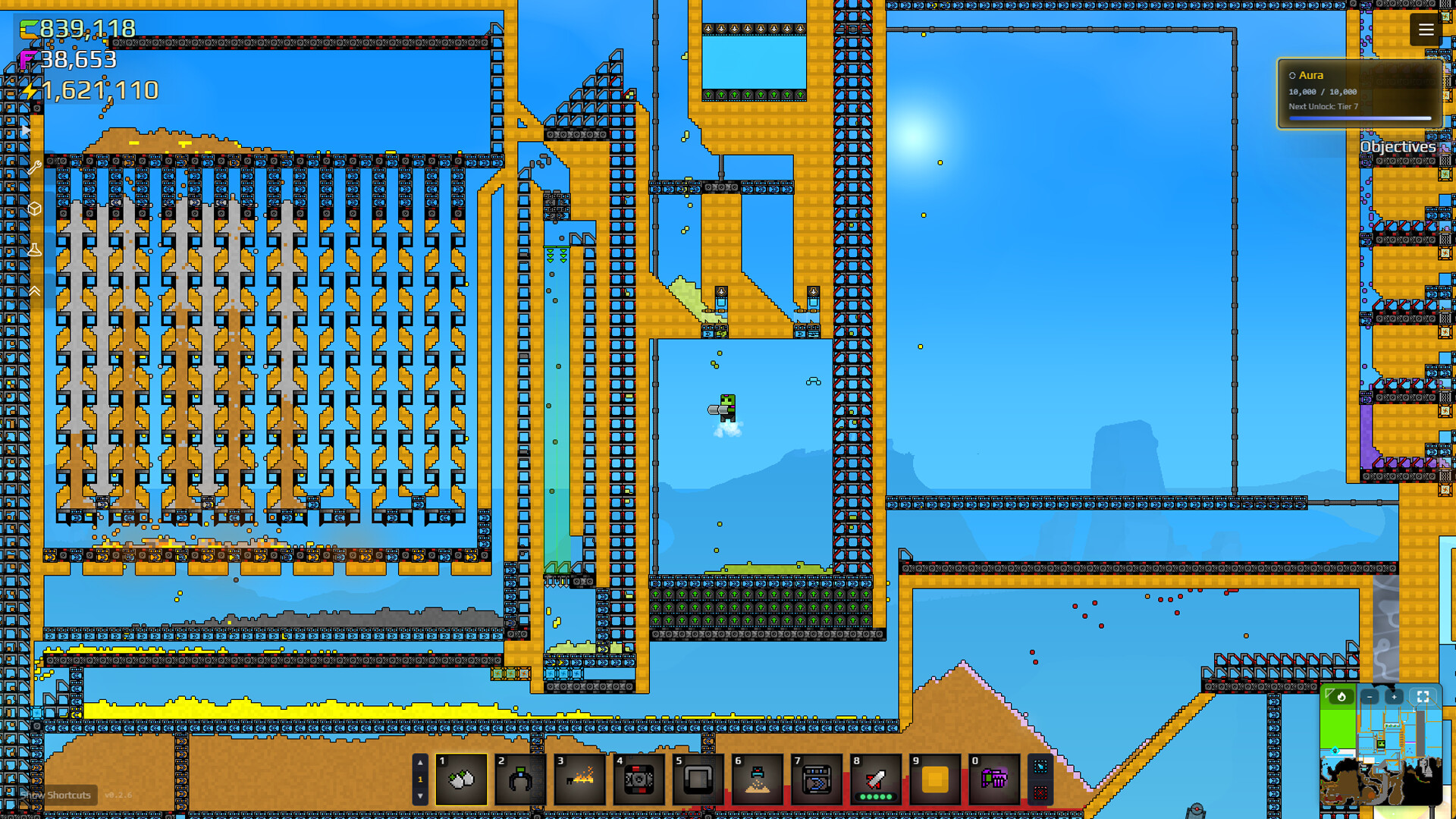
The four parts of a Water network
Water
The official Wiki lists natural Water, Ice, Steam rain and Lumlings among Water sources. These sources do not all have the same availability, setup cost or rate. Treat “where Water exists” and “how Water reaches the factory” as separate questions.
Water also participates in confirmed material reactions. It combines with Sand to form Wet Sand and with Seed to form Wet Seed. Those relationships explain why a Water network often serves several factory systems, but they do not require those systems to share one Pipe network.
Pump
A Pump draws from liquid pixels that touch its grid. Greater immersion can increase flow, but the exact rate is version sensitive and is not confirmed here. When a Pump moves nothing, check physical contact before assuming that the network needs more capacity.
Pipe
Pipes can overlap structures and carry mixed liquids. Connected networks allow multiple Pumps and Liquid Vents to share inputs and outputs. This flexibility is useful for expansion, but it increases the number of places that can influence flow. Separate liquid types and label branches while diagnosing.
Pipe cannot carry Lava. Water touching Lava can produce Steam, but that reaction is not a transport substitute.
Liquid Vent
A Liquid Vent releases liquid from its central area. If the outlet above is blocked, output stops. Leave the outlet visible during the first test instead of covering it with another structure or allowing material to pile over it.
Build the smallest working network
Start with one Pump, one continuous Pipe path and one Liquid Vent.
- Choose a visible Water source.
- Place the Pump where its grid actually touches the liquid.
- Run one continuous Pipe path without branches.
- Connect one Liquid Vent.
- Clear the central outlet and the space immediately above it.
- Confirm Water appears at the outlet before adding a production destination.
Minimum network test
- Input
- One visible Water source touching one Pump
- Transport
- One unbranched Pipe path
- Output
- One Liquid Vent with clear space above
- Success
- Water visibly reaches the outlet
- Not measured
- Exact flow rate or optimal Pump-to-Vent ratio
Only after this route works should you add a second Pump, a second Vent or a branch. Because connected inputs and outputs share a network, every new branch broadens the troubleshooting area.
Where Water comes from and where it goes
The correct source depends on the job.
- Use a confirmed natural source when the objective is a quick transport test, while remembering that this page does not label every natural pool renewable.
- Use the separately documented Snow-to-Steam route when the goal is renewable Water and slow output is acceptable.
- Treat Ice, Steam rain and Lumlings as confirmed source categories, not as interchangeable layouts.
At the destination, Water can form Wet Sand with Sand or Wet Seed with Seed. Build a buffer or visible receiving area before the reaction zone so you can distinguish a transport failure from a missing destination material.
Choose the right Water route
Open Renewable Water when the question is whether Water can be generated repeatedly through Cryoblaster, Snow, Steam and sky exposure. That page explains what the official sources confirm and why “renewable” is more accurate than “instant infinite.”
Open Pumps, Pipes and Water Transport when a Pump moves nothing, a Vent stops, a branch appears starved or unrelated liquids have entered one network.
Open the Beginner Guide when Water is only one stage inside the first Gold, Seed and Flower path.
For Lava, use the Lava transport guide rather than forcing the problem into a Pipe network. Normal Pipes cannot carry Lava.
Diagnose a stopped Water network
Water diagnosis order
- 1Confirm the source still contains Water
- 2Confirm liquid touches the Pump grid
- 3Follow Pipe continuity from input to outlet
- 4Disconnect unexpected shared branches
- 5Clear the Liquid Vent outlet
- 6Confirm the target liquid is supported
- 7Reconnect one branch at a time
The order prevents large rebuilds. For example, adding another Pump cannot clear a blocked Vent, and rerouting a Pipe cannot make Lava supported. Reduce the network to the minimum route, prove it, then restore complexity gradually.
Water FAQ
Can Pipes carry Lava?
No. Current official Pipe and Lava sources explicitly separate Lava from normal Pipe and Pump transport.
Why does my Liquid Vent stop outputting?
Inspect its central outlet and the space above it. A blockage there stops output even when the connected network contains liquid.
Do multiple Pumps share the same Pipe network?
Yes. Multiple Pumps and Liquid Vents on one connected network share inputs and outputs. That enables expansion but also means an unexpected branch can affect the system you are watching.
How do I turn Steam back into Water?
Current official sources say Steam reaching the sky can form Water or rain. The Renewable Water guide keeps that transformation separate from Pump-network troubleshooting and does not promise a fixed production rate.